


Bismarck Airport is a municipal regional airport owned by the City of Bismarck located on the southeastern fringe of city limits. Delta, United, American, and Allegiant operate service there with direct flights to Minneapolis, Denver, Dallas, Chicago, Las Vegas, Orlando (ending in 2025), Phoenix, and Tampa Bay. Some direct destinations are offered seasonally. In 2022, United discontinued its direct flight to Chicago, while Frontier discontinued service entirely. In 2026, American added a direct Chicago flight – filling the void left by United in 2022.
In 2025, Bismarck Airport had almost 310,000 passenger boardings and almost 600,000 total passengers with deplaning included.
History
At the city’s founding, the land containing today’s airport was the site of a tent city known as Burleigh City that sprouted along the original path of the railroad. When the rail line’s path was adjusted north, Burleigh City dissolved.
The first local airplanes landed in a cow pasture across the street of what would later be Jerry’s Supper Club on The Strip. It was moved to lowlands on South Washington Street in the 1920s. The airport moved to its present site southeast of Bismarck in 1931 when the city leased 80 acres of land from F.B. Strauss and Cora McLean. The city later acquired the land in 1940 and purchased an additional 160 acres from the War Assets Administration on what was then part of Fort Lincoln. The Federal Government deeded 46.7 acres to the city for airport purposes in 1963.
The first commercial airplane landed in 1931 when Northwest Airways (later Norwest Airlines, now part of Delta) established Bismarck service. It is the longest-serving airline for Bismarck, and even the sole airline provider for many years.
The first terminal building was constructed in 1936 with the first paved runway four years later. The original terminal was partially financed by a federal grant and originally called Brittin Field.
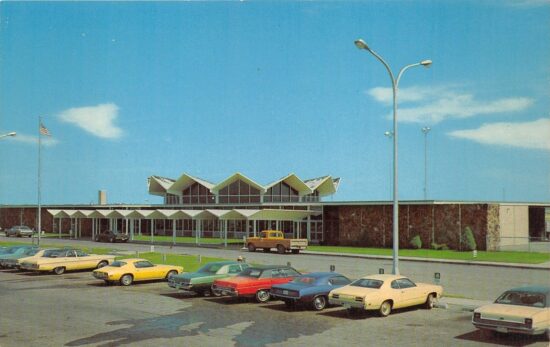
Bismarck Airport, circa 1970s
Plans for a larger airport terminal were laid in 1963 with groundbreaking in April 1965 on the $471,000 new terminal located south and slightly east of the original 1930-era facility, which was located in the vicinity of today’s Executive Air location. The new terminal was part of a total $1.4 million improvement project that also included runway and taxiway upgrades. The replacement terminal, which contained 24 tons of glass with spanning windows, was dedicated in March 1966. University Drive was also curved westward around this time to grant additional room for the airport.
The main runway began reconstruction in 1952 and concluded in 1957. It was lengthened to 6,900 feet in 1963 to accommodate larger aircraft as part of the overall terminal improvement project. It was extended again in 1978 to 8,794 feet.
A new control tower was completed on the site in 1975. It replaced a facility located above one of the hangers. A baggage claim area was added onto the terminal about this time too.
The Airport was greatly expanded in 1984, adding a two-story terminal that offered jet bridge service for the first time. The $3.2 million expansion included a new cafe and housed passenger check-in for the major airlines. The 1966 building continued to house passenger services for the smaller commuter airlines, along with baggage claim and car rental agencies.
Current Terminal
The current facility opened in May 2005 immediately southwest of the 1966 terminal. It was part of a broader $25 million airport improvement project with planning commencing in late 2000 or early 2001. Four options were considered, including renovating and expanding the existing facilities, the oldest section dating back to 1966. Unbeknownst at the time, opting to build an entirely new terminal offered numerous benefits after the events of 9/11 forced airport alterations that could be implemented into the new terminal as opposed to retrofitting the existing.
There is a current study to determine the existing terminal’s future as passenger volume far exceeds its designed capacity of 240,000 annual passengers, which was first exceeded in 2015.
Airlines
Northwest Orient Airlines (today Delta) was the first commercial airline to offer Bismarck flights, and continues to do so. In 1970, Bismarck was served with 16 daily flights offered by Northwest, North Central, and Frontier. Continental and other airlines of varying sizes have come and gone throughout the years.
There was a period through the 1990s when Northwest was the sole carrier offering only direct flights to Minneapolis-Saint Paul. The oil boom and encompassing population growth fueled passenger boardings, luring additional airlines.
Statistics
Bismarck Airport served 35,280 passengers in 1960 and an estimated 122,000 in 1969. Frequency of landings and takeoffs also increased from one every 21.1 minutes in 1960 to one every 6.3 minutes at the end of the decade. Today it exceeds 300,000 annual boardings and almost 600,000 total passengers.